

When people talk about how hard caregiving is, the focus is often on families—and rightly so. But there’s another side of the story that deserves just as much attention.
For PSWs, RPNs, and RNs, caring isn’t something that happens around the edges of life.
It is the work.
It’s the career.
And it’s a lot.
Practitioners don’t just deliver care—they absorb the emotional weight of it every day.
The Weight of Showing Up
Care practitioners walk into people’s homes at vulnerable moments. They see fear, frustration, grief, resilience, and love—sometimes all in the same visit.
They:
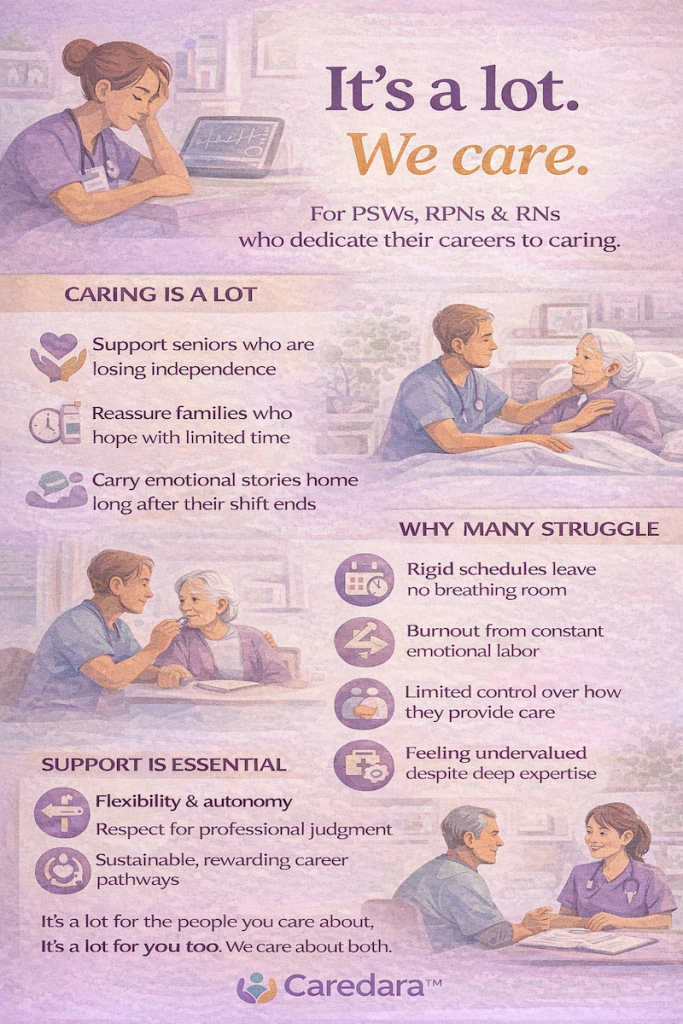
- Support seniors who are losing independence
- Reassure families who are overwhelmed and unsure
- Manage complex needs with limited time and resources
- Carry emotional stories home long after their shift ends
Care work demands presence, patience, and compassion—even when the system around them makes that harder than it should be.
Seeing It Up Close
This reality is deeply personal for many who work in and around care.
“I’ve seen firsthand how challenging caregiving can be—even when families are doing everything they can. There’s a lot of pressure, a lot of emotion, and a lot of responsibility on everyone involved. Practitioners feel that weight too. They care deeply, and they often carry more than people realize.”
— Kylie Cameron, Co-Founder, Caredara™
Practitioners don’t just manage tasks—they manage human moments. And those moments stay with them.
Caring as a Career Isn’t Easy
Many practitioners entered care because they wanted to make a difference. But over time, the demands can become overwhelming:
- Rigid schedules that leave little room for life
- Burnout from constant emotional labour
- Feeling undervalued despite deep expertise
- Limited control over how and when they work
- Little recognition for the relational side of care
When care becomes unsustainable, even the most dedicated practitioners are forced to step back—or step away entirely.
And when they do, everyone feels the loss.
It’s a Lot — For Practitioners Too
Care systems often acknowledge that clients and families are overwhelmed. What’s discussed less is how much practitioners are also carrying.
They’re asked to:
- Be clinically precise
- Be emotionally present
- Be endlessly flexible
- Be resilient in the face of systemic gaps
All at once.
That’s not just hard—it’s unsustainable.
What Support Should Look Like
Supporting practitioners doesn’t mean asking them to care less. It means creating conditions where caring doesn’t come at the cost of their well-being.
Support looks like:
- Flexibility and autonomy
- Respect for professional judgment
- Systems that reduce friction instead of adding to it
- Career paths that allow practitioners to grow, adapt, and stay in care on their own terms
- Tools and structures that recognize care as both skilled and human work
When practitioners are supported, care becomes better for everyone.
Why This Matters
Care doesn’t happen in isolation. When practitioners are stretched too thin, continuity breaks. Trust erodes. Quality suffers. Families feel it. Seniors feel it.
Supporting practitioners isn’t separate from supporting families—it’s foundational to it.
It’s a Lot. We Care.
At its heart, this message applies to everyone involved in care.
Yes, it’s a lot for families navigating complex needs.
But it’s also a lot for the practitioners who show up day after day, carrying skill, compassion, and responsibility into every home they enter.
Caredara™ exists because we understand that care is demanding—for those receiving it and those providing it. Quietly, intentionally, we are working to support practitioners as whole people—not just as workers filling shifts.
Because caring deeply shouldn’t mean carrying everything alone.
It’s a lot.
We care.