

Hallway Caregiving: The Quiet Crisis Happening in Canadian Homes
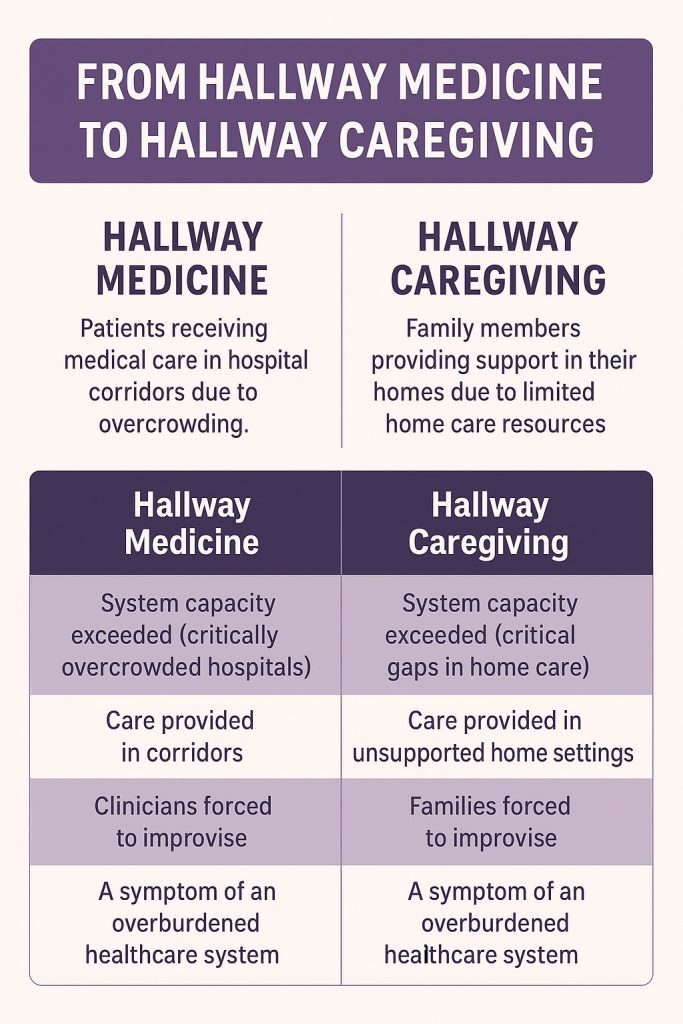
For years, Canadians have heard about “hallway medicine”—patients receiving care in corridors, waiting rooms, and makeshift spaces because hospitals are overwhelmed. It became a symbol of a system under strain, forced to operate outside its intended design.
But while hallway medicine happens in public view, a quieter, more invisible version of this crisis is unfolding every day—inside people’s homes.
It’s called hallway caregiving.
What Is Hallway Caregiving?
Hallway caregiving refers to the growing reality where unpaid family members are forced to provide care in the “gaps” of the healthcare system, without proper support, training, or relief—often stepping in immediately after hospital discharge or when formal home care is unavailable.
These caregivers aren’t literally standing in hallways.
They’re standing in the in-between spaces of the system—between hospital and home, between public and private care, between what’s needed and what’s available.
“Hallway caregiving is what happens when families become the default care plan,” says Dr. John-Paul Hatala, who coined the term.
“It’s the home-based equivalent of hallway medicine—care happening not because it’s ideal, but because there’s nowhere else for it to go.”
The Parallels to Hallway Medicine
The similarities are striking:
|
Hallway Medicine |
Hallway Caregiving |
|---|---|
|
Patients treated in corridors |
Care provided in unsupported home settings |
|
System capacity exceeded |
Home care capacity exceeded |
|
Clinicians forced to improvise |
Families forced to improvise |
|
Temporary solutions becoming permanent |
Emergency caregiving becoming the norm |
Both are symptoms of the same underlying issue: a system designed for yesterday’s population, not today’s reality.
The Human Cost Behind the Term
Hallway caregiving isn’t theoretical—it’s deeply personal.
In Canada:
- Over 8 million people are unpaid caregivers
- They provide 5+ billion hours of care annually
- Nearly 50% report stress, burnout, or declining mental health
- Many are balancing caregiving with full-time work and parenting
These caregivers are managing medications, mobility, wound care, dementia behaviors, and emotional support—often with no formal training and little backup.
And unlike hallway medicine, hallway caregiving happens behind closed doors, largely unseen.
Why Hallway Caregiving Is Becoming the Norm
Several forces are colliding:
1. Faster Hospital Discharges
Seniors are being sent home “quicker and sicker,” with families expected to pick up complex care immediately.
2. Limited Public Home Care
Government-funded care is often capped, delayed, or insufficient.
3. Workforce Shortages
PSWs, RPNs, and RNs are in critically short supply, leaving gaps families must fill.
4. An Aging Population
By 2031, nearly 1 in 4 Canadians will be over 65, dramatically increasing care needs.
The result? Families become the pressure valve for a strained system.
Why This Should Concern Everyone
Hallway caregiving isn’t just a caregiver issue—it’s a system sustainability issue.
When caregivers burn out:
- Seniors end up back in hospital
- Emergency departments see avoidable admissions
- Long-term care placements accelerate
- Workforce participation declines
- Mental health costs rise
In other words, hallway caregiving creates downstream consequences everywhere else.
The Need for a New Care Model
Addressing hallway caregiving requires more than sympathy—it requires structural change.
That includes:
- More flexible, on-demand home care options
- Better transitions from hospital to home
- Support for caregivers, not assumptions
- Innovative models that blend professional care with family support
- Technology that reduces friction and wait times
- Care systems designed around real lives, not ideal workflows
The solution isn’t to ask families to do more—it’s to stop designing systems that depend on them doing everything.
Naming the Problem Is the First Step
Hallway medicine changed the conversation about hospital care because it gave people language for what they were already seeing.
Hallway caregiving does the same.
It names a reality millions of Canadians are living every day—quietly, compassionately, and often at great personal cost.
And once a problem has a name, it can no longer be ignored.