

Across Canada, thousands of seniors have been assessed as needing long-term care—but remain at home, waiting. Waiting months. Sometimes years. And during that wait, a quiet crisis unfolds inside families.
This is hallway caregiving in action.
Just as hallway medicine describes care delivered in hospital corridors because beds are unavailable, hallway caregiving describes what happens when families become the holding space for a system that has no room.
The Reality of Waiting for Long-Term Care
In Ontario, the numbers are stark:
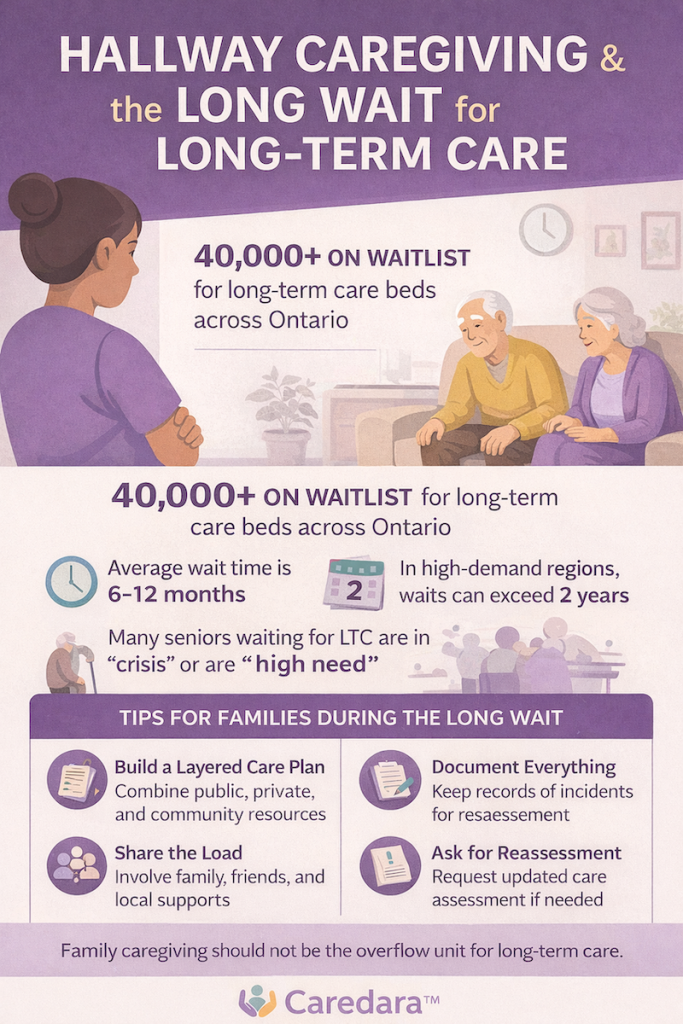
- The average wait time for a long-term care bed is 6–12 months
- In high-demand regions, waits can exceed 2 years
- Over >40,000 people are currently on LTC waitlists at any given time
- Many seniors waiting for LTC are classified as “crisis” or “high need”
Yet while the system waits, families act.
They manage medications, mobility, dementia-related behaviors, incontinence, meals, and safety—often without training or support.
This is hallway caregiving:
care happening not because it’s appropriate, but because there is nowhere else for it to go.
The Cost of the Wait
Waiting for LTC isn’t passive—it’s demanding and often destabilizing.
For seniors:
- Increased risk of falls, medication errors, and isolation
- Worsening dementia symptoms without consistent professional support
- Frequent emergency department visits
- For families:
- Emotional and physical burnout
- Reduced work hours or job loss
- Financial strain from filling care gaps privately
- Chronic stress from “holding things together” indefinitely
Many families describe living in constant limbo—never sure if today will be manageable or the day things fall apart.
Why Hallway Caregiving Becomes the Default
Several system pressures converge during the LTC wait:
- Limited Home Care Hours
Publicly funded home care is often capped and insufficient for high-needs seniors.
- Hospital Discharge Pressure
Seniors are discharged home to wait for LTC because hospitals need beds.
- LTC Capacity Constraints
Even when a senior is approved, placement depends on availability, location, and preferred homes.
- Workforce Shortages
PSWs, RPNs, and RNs are in critically short supply across sectors.
The result: families absorb the pressure.
What Families Can Do While Waiting
While no family should have to navigate this alone, there are steps that can help stabilize care during the wait:
1. Build a Layered Care Plan
Combine public home care with private or supplemental support if possible. Even a few additional hours can reduce risk and burnout.
2. Prioritize Safety First
Focus on fall prevention, medication management, and overnight risks. Addressing these can prevent avoidable hospital visits.
3. Document Everything
Keep records of incidents, hospital visits, and care challenges. This documentation can be critical if a senior’s status needs to be reassessed as “crisis.”
4. Share the Load
Involve multiple family members, friends, or community supports. No single person should carry full responsibility.
5. Ask for Reassessment When Needed
If a senior’s condition deteriorates, families can request an updated care assessment—waiting status is not static.
6. Seek Flexible, On-Demand Support
Care that can be scheduled around real needs—not rigid blocks—can help families bridge gaps during uncertain waiting periods.
Why This Requires System-Level Change
Hallway caregiving during LTC waits is not a personal failure—it’s a structural one.
A system that relies on unpaid families to manage high-needs care for months or years is:
- Unsustainable
- Inequitable
- Risk-prone
- Emotionally costly
Families should not be the overflow unit for long-term care.
Naming the Gap Matters
Hallway caregiving gives language to what families experience while waiting for LTC:
care delivered in the margins of the system, held together by love, exhaustion, and improvisation.
Naming it matters—because problems without names are easy to ignore.
And families waiting for long-term care deserve more than waiting rooms without walls.
They deserve support, dignity, and a system that meets them before crisis hits.