

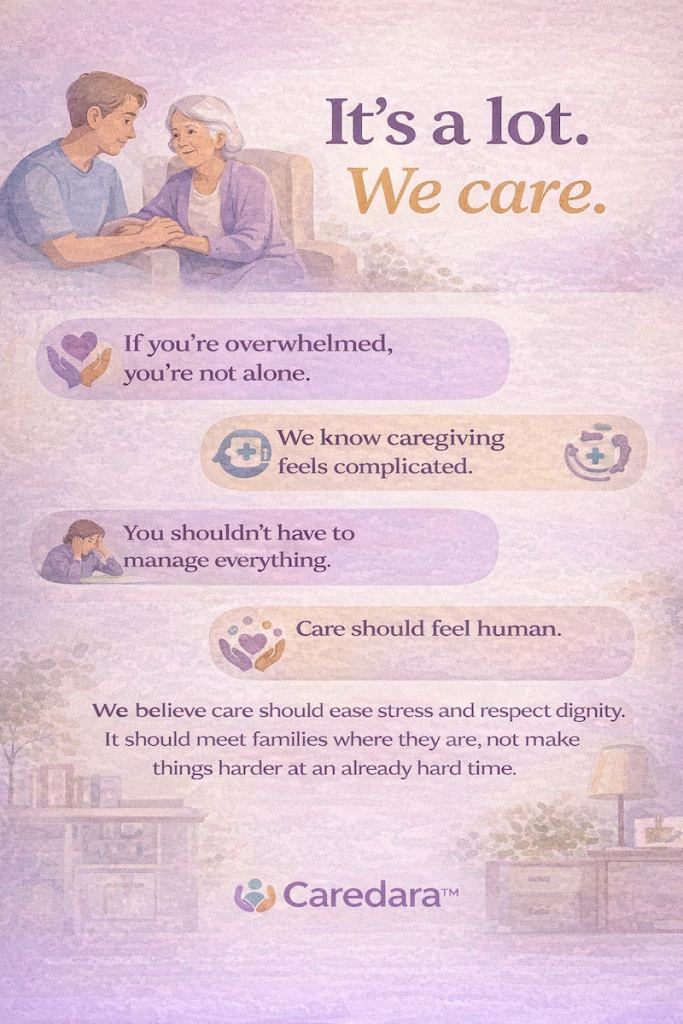
Caring for someone you love can be overwhelming in ways that are hard to put into words. It’s the coordination. The decisions. The waiting. The guilt. The constant feeling that you should be doing more, even when you’re already stretched thin.
For many families, care doesn’t arrive all at once. It creeps in gradually—an extra appointment here, a new medication there—until one day you realize that life has quietly reorganized itself around caring for someone else.
And it’s a lot.
Not just physically, but emotionally. Mentally. Logistically.
If you’re feeling this way, you’re not failing. You’re responding to a system that asks families to carry more than they ever expected.
When Care Becomes Personal
I understand this not just professionally, but personally.
“I’ve watched my own mother navigate a system that is fragmented, slow to respond, and often difficult to understand. As her needs have changed, our family has had to adapt—sometimes without clear guidance, sometimes without enough support. Living through that has made it impossible for me not to see what families are up against every day.”
— Dr. John-Paul Hatala, Founder Caredara™
What looks like a policy problem on paper feels very different when it’s your family. When it’s your phone ringing late at night. When it’s your calendar filling with appointments. When it’s the quiet worry that sits with you even on good days.
That lived experience is shared by millions of families—whether they call themselves caregivers or not.
The Quiet Weight Families Carry
Today, unpaid caregivers provide billions of hours of care across Canada. Many are balancing full-time work, parenting, and caregiving all at once. Others are navigating complex health needs with little training or backup.
The system often assumes families will “figure it out.”
And most do—because they care.
But caring shouldn’t mean carrying everything alone.
What Care Should Feel Like
At its core, care should feel human. It should feel responsive. It should meet people where they are—rather than asking them to conform to rigid systems, limited windows, or long waits.
Care should:
- Reduce stress, not add to it
- Adapt as needs change
- Respect the dignity of seniors
- Support families, not silently rely on them
- Value the people who provide care, both paid and unpaid
When those things are missing, families are left holding the weight.
A Different Way of Thinking About Care
There is a growing recognition that home care needs to be more flexible, more responsive, and more grounded in real life. Not just technologically smarter—but emotionally smarter.
That shift starts with acknowledging what families already know:
It’s complicated.
It’s exhausting.
It’s emotional.
It’s a lot.
And caring systems should reflect that reality.
Why We’re Here
Caredara™ exists because of moments like these—moments where families feel stuck between loving someone deeply and navigating a system that doesn’t always make space for that love.
Quietly, intentionally, and thoughtfully, we are working toward a future where care feels less overwhelming and more supportive. Where families feel seen. Where practitioners are empowered. Where access is clearer, and help arrives when it’s needed—not just when it’s available.
We don’t pretend care is easy.
We just believe it should be better.
Because it’s a lot.
And caring means understanding that first.