

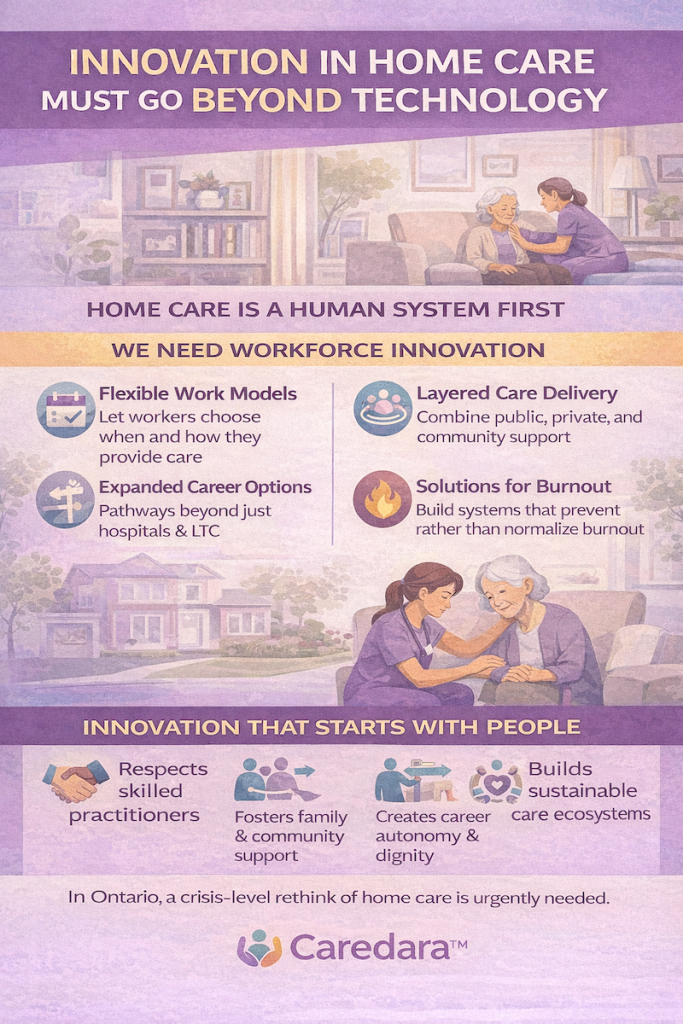
When people talk about innovation in home care, the conversation often turns quickly to technology—apps, platforms, dashboards, and digital tools. While technology has an important role to play, innovation in home care cannot be a tech-only conversation.
The deeper, more urgent need is workforce innovation.
Because without rethinking how care work itself is structured, supported, and valued, no amount of technology will fix what’s broken.
The Limits of Tech-Only Solutions
Technology can improve efficiency, coordination, and access—but it cannot solve:
- A workforce that feels undervalued
- Care roles designed around inflexible schedules
- Career pathways that force practitioners into narrow tracks
- Systems that assume unlimited caregiver capacity
Digital tools layered onto outdated models simply move inefficiencies faster. Real innovation requires reimagining the work, not just the software that supports it.
Home Care Is a Human System First
Home care is built on relationships, trust, and presence. Any innovation that ignores the human realities of care will fall short.
Care practitioners—PSWs, RPNs, and RNs—need systems that reflect:
- The physical and emotional demands of the work
- The desire for flexibility and autonomy
- The importance of continuity and meaningful connections
- The need for sustainable, long-term careers
Innovation must start with the question:
What does it take for care workers to thrive—not just function?
Workforce Innovation Means Redesigning the Role
True innovation in home care includes:
- Flexible work models that allow practitioners to choose when and how they work
- Layered care delivery, where different levels of support can be combined as needs change
- Expanded career options beyond hospitals and long-term care
- Recognition of expertise, not just task completion
- Systems that reduce burnout instead of normalizing it
This isn’t about doing less—it’s about doing care differently.
The Case for New Care Ecosystems
Home care does not exist in isolation. It intersects with hospitals, long-term care, families, and communities. Innovation must reflect that reality.
A modern care ecosystem:
- Allows care to scale up or down quickly
- Supports both professionals and family caregivers
- Reduces pressure points instead of shifting them
- Enables continuity across settings, not fragmentation
When care systems are designed as ecosystems rather than silos, access improves—and strain decreases across the board.
Innovation That Attracts and Retains Talent
Ontario—and Canada more broadly—cannot meet future care needs without keeping skilled practitioners in the field.
Workforce innovation is one of the most powerful retention tools available:
- Autonomy increases engagement
- Flexibility reduces burnout
- Choice restores dignity to care work
- Sustainable models attract new entrants
People don’t leave caregiving because they don’t care.
They leave because the system makes it too hard to stay.
Rethinking What Progress Looks Like
Innovation in home care shouldn’t be measured only by speed or scale. It should be measured by:
- Whether practitioners stay longer
- Whether families feel supported
- Whether seniors experience continuity and dignity
- Whether care feels human, not transactional
Progress is not just faster care—it’s better care for everyone involved.
Looking Ahead
The future of home care will not be built by technology alone. It will be built by systems that respect care work as skilled, relational, and essential—and by innovation that starts with people, not platforms.
If we want home care to be sustainable, compassionate, and accessible, we must innovate where it matters most: in how we support the people who provide it.
Because the most important innovation in home care isn’t digital.
It’s human.