

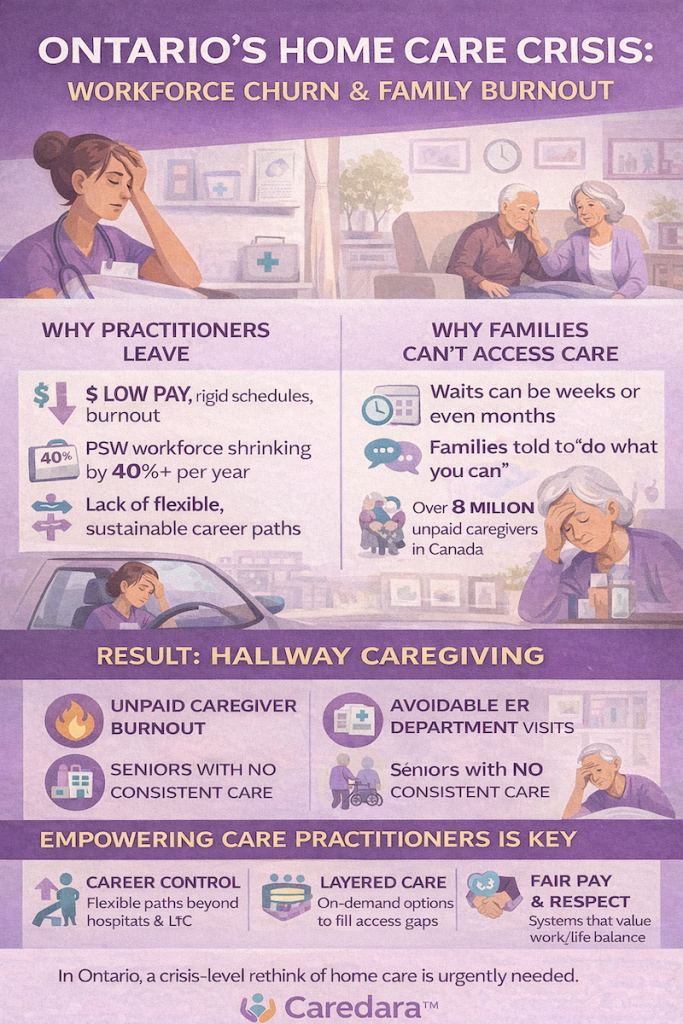
Ontario’s home care system is under extraordinary strain. Families are struggling to access reliable, high-quality care. Seniors are waiting—sometimes indefinitely—for support. And the very workforce the system depends on is leaving in alarming numbers.
At the centre of this crisis is a difficult truth:
care workers are not staying because the system is not working for them—and when they leave, families are left to fill the gap.
This is how hallway caregiving becomes the norm.
A Workforce That Can’t Afford to Stay
Personal Support Workers (PSWs), Registered Practical Nurses (RPNs), and Registered Nurses (RNs) are the backbone of home care. Yet Ontario is losing them at a pace the system cannot sustain.
- PSW turnover rates exceed 40% annually
- Thousands of trained workers leave home care for other sectors—or leave healthcare altogether
- Many cite low pay, rigid schedules, lack of autonomy, and burnout as primary reasons
- Even experienced RPNs and RNs are increasingly opting out of traditional hospital and LTC pathways
This isn’t a lack of people who want to care—it’s a lack of systems that allow them to do so sustainably.
When the Workforce Leaves, Access Collapses
Every practitioner who leaves home care creates a ripple effect:
- Fewer available hours for publicly funded care
- Longer waits for families trying to arrange support
- Reduced continuity and consistency for seniors
- Increased reliance on unpaid family caregivers
Families are often told care is “approved” but not available. Access exists on paper—but not in practice.
This gap is where hallway caregiving takes hold.
The Hidden Cost: Unpaid Caregiver Burnout
Ontario families are quietly absorbing the shock of a shrinking workforce.
- Over 8 million Canadians are unpaid caregivers
- Many provide 20–30+ hours of care per week on top of work and family obligations
- Nearly half report stress, burnout, or declining mental health
They are managing complex care needs—medications, mobility, dementia behaviors—not because they are trained to, but because no one else is available.
Hallway caregiving isn’t about choice.
It’s about necessity.
A Double-Edged Crisis
This crisis cuts both ways:
- Practitioners leave because the system doesn’t treat them fairly or sustainably
- Families suffer because access to care becomes unreliable or nonexistent
The result is churn:
- High-quality practitioners cycle out
- Families cycle into burnout
- Seniors cycle through hospitals, emergency departments, and unstable care
This is not a people problem.
It is a design problem.
Why Empowering Practitioners Is the Key
Addressing hallway caregiving requires addressing the workforce first.
Care systems must:
- Empower PSWs, RPNs, and RNs with autonomy
- Allow practitioners to control their schedules, workloads, and career paths
- Recognize care work as skilled, valuable, and worthy of respect
- Create alternatives to the narrow hospital → LTC career pipeline
Many practitioners want flexibility.
They want to practice differently.
They want to build sustainable careers without burning out.
The system must let them.
Toward a Layered, On-Demand Care Ecosystem
A future-ready home care system must be built around layered access:
- Public care as a foundation
- Flexible, on-demand options to fill gaps
- Professional care that can scale up or down as needs change
- Support models that reduce pressure on families—not shift it onto them
When care is layered and accessible, hallway caregiving becomes the exception—not the rule.
Career Pathways Beyond the Traditional System
To retain talent, Ontario must expand what a “care career” looks like.
That means:
- New pathways outside hospitals and long-term care
- Opportunities for practitioners to work independently, collaboratively, and flexibly
- Systems that reward quality, continuity, and compassion—not volume alone
When practitioners can build careers that fit their lives, they stay.
When they stay, access improves.
When access improves, families can breathe.
In the Era of Hallway Caregiving, This Is Essential
Hallway caregiving is not a temporary phenomenon—it’s a warning signal.
It tells us:
- Families are carrying too much
- Practitioners are leaving because they must
- The system is depending on invisible labour to function
The path forward is not asking families to do more—it’s building systems that support everyone involved in care.
Ontario’s home care crisis will not be solved with small fixes.
It requires reimagining how care is delivered, accessed, and valued.
Because care should not live in the margins.
And families should not be the overflow unit for a system that hasn’t caught up with reality.