

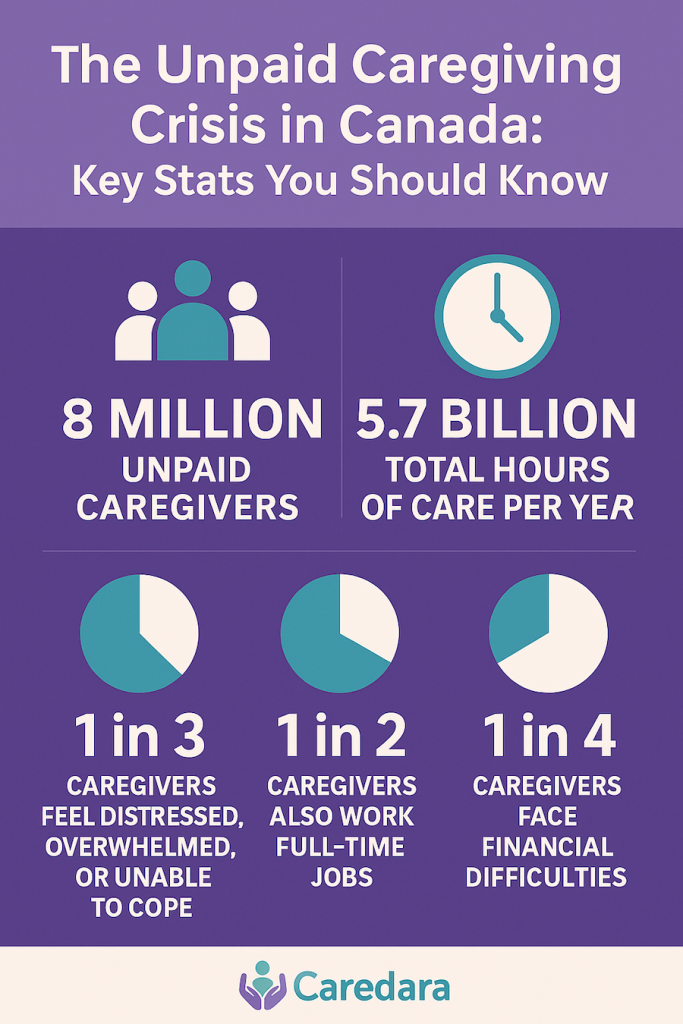
Across Canada, more than 8 million unpaid caregivers—family members, friends, neighbours—provide essential support to aging or ill loved ones. They are the hidden backbone of the healthcare system, quietly filling the gaps left by limited home care resources, workforce shortages, and long waitlists.
But the strain on unpaid caregivers has reached a breaking point. Their emotional, physical, and financial sacrifices reveal an urgent truth: the current system is not sustainable. Change is no longer optional—it’s necessary.
The Weight They Carry
Unpaid caregivers provide an estimated 5.7 billion hours of care each year—worth more than $97 billion if compensated at professional rates. Yet most do this without training, without support, and often without recognition.
According to Statistics Canada and the Canadian Centre for Caregiving Excellence:
- 1 in 3 caregivers feel overwhelmed by their responsibilities.
- Over 45% report symptoms of stress, burnout, or emotional exhaustion.
- Nearly 50% of caregivers also work full-time jobs, juggling home, work, and care.
- <1 in 4 experience financial hardship due to reduced work hours or out-of-pocket care expenses.
These aren’t small numbers—they are signals of a system leaning heavily on the unpaid labour and love of Canadians who are simply doing their best.
The Hidden Toll on Caregivers
Behind every hour of unpaid care is a person trying to manage:
- Sleepless nights checking on a parent with dementia
- Interrupted workdays due to medical appointments or emergencies
- Financial strain from covering home care tasks the system can’t
- Chronic stress from navigating care plans, medications, and hospital discharges
- Isolation, as social circles shrink and responsibilities grow
Caregivers step in because they care—but caring doesn’t mean they should carry the entire load alone.
Why the System Must Change
Canada’s population is aging faster than ever. By 2031, nearly 25% of Canadians will be over 65, dramatically increasing the need for home care.
Meanwhile:
- There are severe shortages of PSWs, RPNs, and RNs.
- Home care agencies are struggling to keep staff.
- Waitlists for government-funded care continue to grow.
This leaves unpaid caregivers doing more and more—without the training, resources, or support they deserve.
The system’s reliance on unpaid labour is unsustainable, unfair, and unsafe.
A New Model for Care
The future of home care must include:
 More accessible, flexible paid home care options
Programs that relieve burden rather than shift it
Support systems for caregivers—financial, emotional, and practical
Better integration between hospitals, community health, and home care
Technology that connects families with care when and where they need it
Care must be a shared responsibility—between families, communities, professionals, and modern tools that make navigating care easier and more accessible.
Looking Ahead
Unpaid caregivers have held up the system for too long. Their resilience is admirable, but resilience is not a strategy—and it should not be what the healthcare system depends on.
Change is urgently needed to support the people who support everyone else.
Because no caregiver should have to choose between their loved one’s well-being and their own.