

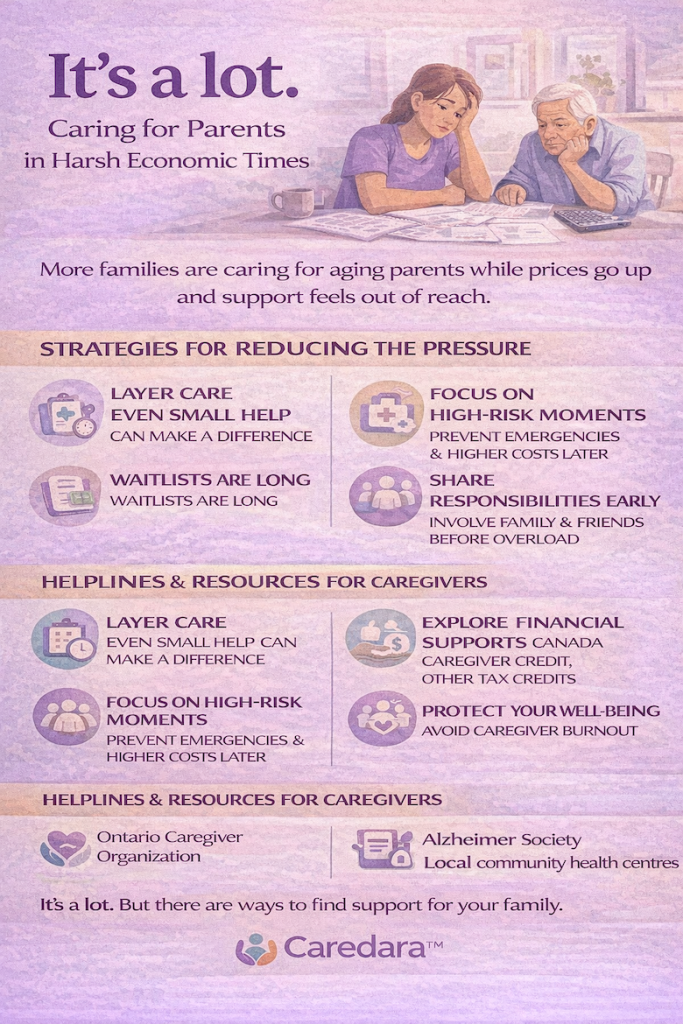
For many families right now, life feels heavier than it used to. Groceries cost more. Housing costs are up. Work feels less secure. And at the same time, more Canadians are finding themselves caring for aging parents—often unexpectedly.
Care doesn’t pause for inflation.
Needs don’t wait for financial stability.
And systems don’t always respond when families need them most.
It’s a lot.
When Care and Cost Collide
More families are being asked to do more with less. Parents need help with daily living, appointments, medications, or safety—but accessing care isn’t straightforward.
Public home care can be limited or delayed.
Long-term care waitlists are long.
And private-pay home care, while often essential, can be expensive—especially when care is needed regularly.
Families are left doing the math:
- How long can we manage on our own?
- What can we afford?
- What happens if things get worse?
There are no easy answers—only difficult trade-offs.
The Emotional Weight of Financial Stress
Caring for a parent is already emotional. Adding financial strain compounds the stress.
Many caregivers describe:
- Guilt for not being able to “do more”
- Anxiety about running out of money
- Tension between siblings about decisions
- Exhaustion from constantly problem-solving
The pressure isn’t just logistical—it’s deeply personal.
And too often, families carry it quietly.
When the System Doesn’t Meet Reality
Care systems were not designed for today’s economic reality. They assume:
- Families can fill gaps indefinitely
- Care needs progress slowly and predictably
- Paid support is accessible when required
But real life is messier.
Care needs change suddenly.
Costs accumulate quickly.
And families are forced to adapt in real time.
This is where overwhelm sets in.
It’s a Lot — and You’re Not Alone
Acknowledging how hard this is matters.
You’re not failing because care feels overwhelming.
You’re responding to a situation that is overwhelming.
The goal isn’t to solve everything at once—but to reduce pressure where possible.
Practical Strategies to Help Manage the Load
While no solution is perfect, these strategies can help families navigate care during financially challenging times:
1. Layer Care, Don’t Go All-or-Nothing
Care doesn’t have to be constant to be helpful. Even a few hours of professional support per week can:
- Reduce burnout
- Improve safety
- Give caregivers time to rest or work
Start small and adjust as needs change.
2. Focus on the Highest-Risk Moments
Prioritize support around:
- Bathing and mobility
- Medication management
- Overnight supervision
- Post-hospital discharge
Addressing these areas can prevent emergencies that lead to higher costs later.
3. Share Responsibilities Early
Waiting until someone is exhausted makes everything harder. Involve siblings, extended family, or friends sooner rather than later—even if support looks different for each person.
4. Explore Financial Supports and Tax Credits
Many families don’t realize what help is available.
In Canada, consider:
- Canada Caregiver Credit (CCC)
- Disability Tax Credit (DTC) (if applicable)
- Employment Insurance Caregiving Benefits
- Provincial programs and caregiver grants
Speaking with a tax professional or social worker can uncover supports you didn’t know existed.
5. Ask for Reassessment When Needs Change
Care eligibility isn’t static. If a parent’s condition worsens, families can request reassessment for additional public supports.
Document changes and advocate clearly.
6. Protect Your Own Well-Being
Caregiving during economic stress increases the risk of burnout. Simple steps—sleep, boundaries, emotional support—are not luxuries. They are necessities.
You matter too.
Helpful Resources
- Ontario Caregiver Organization – education, helplines, and peer support
- Canada.ca Caregiving Benefits & Credits – federal financial supports
- Alzheimer Society (if applicable) – education and caregiver programs
- Local community health centres – navigation support and referrals
Reaching out for information is not weakness—it’s preparation.
A Final Thought
Caring for aging parents in uncertain economic times is not something most families planned for. It arrives quietly, grows steadily, and often feels overwhelming before anyone names it.
It’s a lot.
But acknowledging the weight of it—financially, emotionally, practically—is the first step toward finding support, reducing strain, and making sustainable decisions.
You’re not alone in this.
And you don’t have to carry it all at once.